Why dental can't afford to only watch dental.
I spent the first week of October at Advertising Week New York. It is not a dental conference, and that is the point.
Advertising Week brings together marketers from media, retail, tech and healthcare. The 2026 event ran October 5 to 8 in Manhattan's Penn District, with more than 1,300 speakers and over 500 sessions. Dental is a small corner of that world.
The dental industry needs to see what is going on in the advertising world at large. That is where the changes start, and they always reach our practices. Most dental marketing advice still comes from dental conferences and dental vendors. These broader events are important and differentiated, because you see the shifts before they show up in your patients' behavior.
Here are the three lessons I brought back for dental and medical practices.
Key takeaways
- Connected TV lets a practice reach the households around its office and judge it on calls and booked appointments, not impressions.
- Streaming reached 48.5% of all US TV viewing in June 2026, and IAB projects CTV ad spending will grow 11% to $29.3 billion in 2026.
- Every performance channel runs on trust: the ad gets the click, trust gets the booking.
- 75% of patients won't book with a provider rated below 4.0 stars, and 66% say a provider's response to reviews affects their trust.
- AI is moving from discovery to booking, so your hours, services, insurance and availability have to be accurate and bookable by machines.
Lesson 1: TV is now a local, measurable channel
TV used to mean one thing for a practice: an expensive broadcast buy across an entire market. Most of that money reached people who would never drive 40 minutes to your office. Connected TV (CTV) has changed the math.
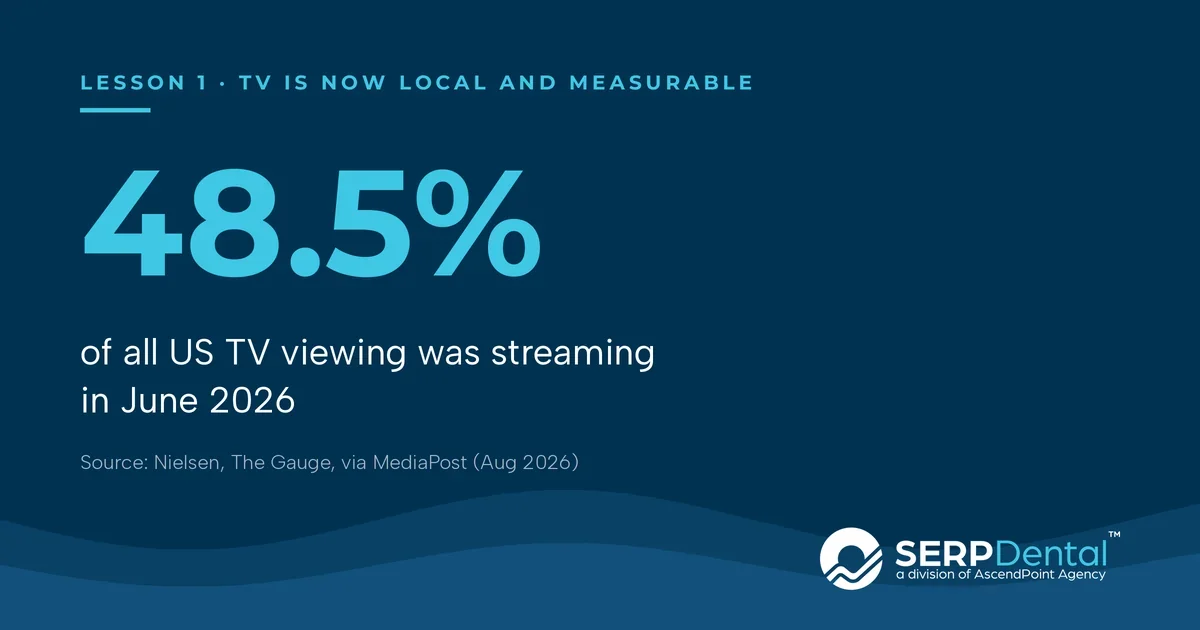
The audience has already moved. Streaming reached 48.5% of all US TV viewing in June 2026, compared with 19.8% for broadcast and 19.5% for cable, according to Nielsen's The Gauge (MediaPost). The money is following. IAB projects CTV ad spending will grow 11% to $29.3 billion in 2026 (MediaPost).
The bigger shift is how success is measured. At Advertising Week, Mattress Firm CMO Tom Murray and iSpot President and CRO Julie Van Ullen walked through how Mattress Firm moved its TV creative from storytelling toward measurable results like revenue and foot traffic (iSpot). Storytelling still matters. But the creative has to be built to drive a result you can track.
What this means for practices: CTV is no longer only for national brands. A practice can reach the households around its office on the same screen patients use for Netflix and YouTube, then judge it on calls and booked appointments, not impressions. Practices that test it early, with tight geography and real call tracking, will learn what works before their competitors do.
Lesson 2: You can't have performance without trust
Every performance channel runs on trust. If a patient doesn't trust what they find after they click, call or search, the media spend is wasted.
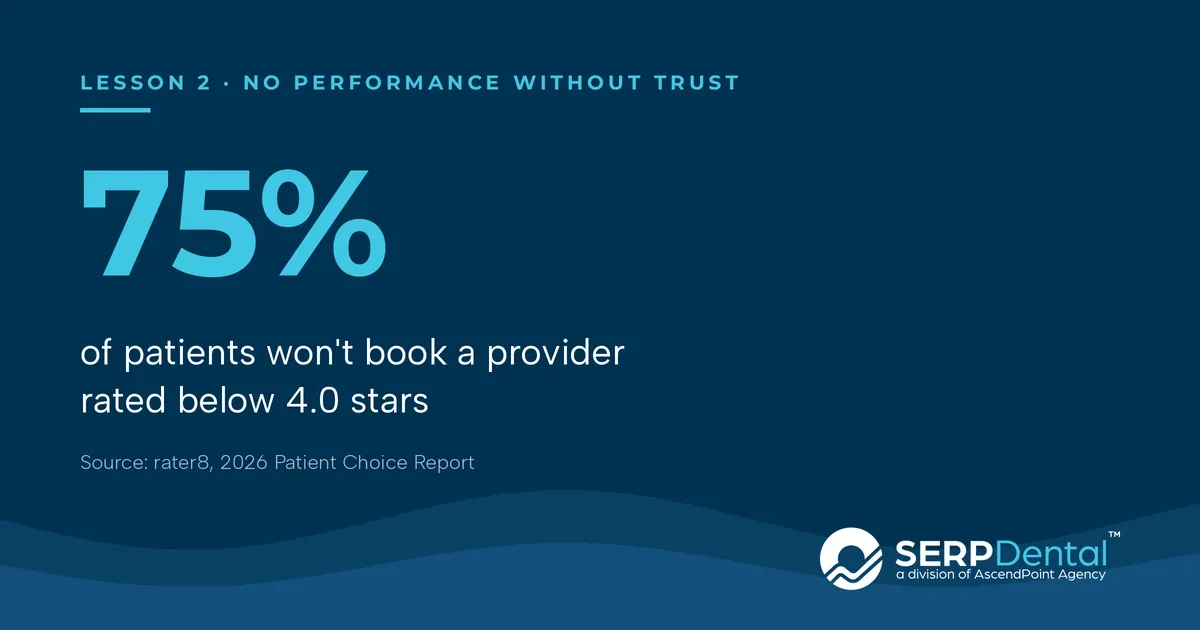
Patients now check before they book. In rater8's 2026 Patient Choice Report, 75% of patients said they won't book with a provider rated below 4.0 stars, and 55% have canceled or avoided a booking because of online reviews, up from 40% in 2025 (rater8). The same survey found 66% say a provider's response to reviews affects their trust. rater8 sells reputation software, so read its numbers with that in mind, but the direction matches what we see every day.
The path to a booking is also not a straight line. About 84% of US consumers who look for health information online use search engines, per EMARKETER's Healthcare Consumer 2026 research (EMARKETER). Then they read reviews, ask friends, check insurance and, increasingly, ask AI.
Kamal Bhandal, SVP of the global Invisalign brand at Align Technology, made the case on Advertising Week's Wellness, Work & Wellbeing podcast that brands have to earn trust before they can expect it, and that education is central. Bhandal tied it directly to explaining how oral health connects to overall health (Advertising Week). That is where dentistry and medicine are converging.
What this means for practices: Treat reviews, review responses and educational content as part of your media plan, not a separate chore. The ad gets the click. Trust gets the booking.
Lesson 3: AI is moving from discovery to agentic transactions
AI was in nearly every session at Advertising Week. The conversation has moved past "will patients use AI to find a doctor?" They already do. The next step is AI that books the appointment for them.
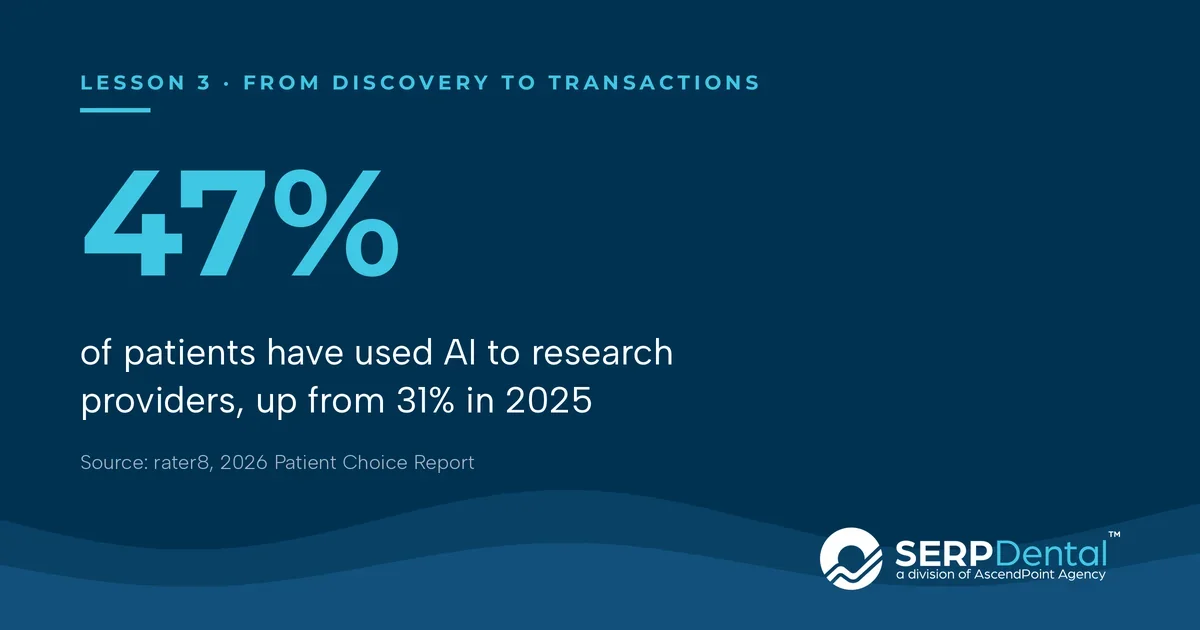
Discovery has already shifted. A KFF poll conducted in early 2026 found 32% of US adults used AI chatbots for health information in the past year (Becker's Hospital Review). In rater8's survey, 47% of patients have used AI to research providers, up from 31% a year earlier. Among patients who switched providers, AI was the top influence at 39% (rater8). For more on this shift, read how patients use AI to find a dentist and our guide to showing up in AI-powered search.
Transactions are next, and they are arriving now:
- Gemini books appointments. In August 2026, Zocdoc became the first health appointment partner in Google's Gemini app. US users can search and book in real time inside the chat, across more than 200,000 providers (HIT Consultant).
- Google Search is heading the same way. Google's AI Mode started with agentic restaurant reservations and said local service appointments come next (Search Engine Journal).
What this means for practices: Being mentioned by AI is no longer enough. Your hours, services, insurance and availability have to be accurate and bookable by machines, not just readable by people. When an AI agent is choosing between two practices, the one it can actually book wins. And once the patient walks in, your team still has to deliver the experience that earns the next review.
What practices should do next
The practices that grow over the next five years won't be the ones that only watch dental. They'll be the ones watching where the entire industry is headed, and moving first.
- Test CTV locally. Start with a tight radius around the office and track calls and booked appointments, not impressions.
- Run trust like a channel. Ask every happy patient for a review, respond to every review, and publish clear educational content on your top services.
- Get bookable by AI. Keep your Google Business Profile, hours, services and insurance accurate everywhere, and make online booking available.
- Look outside dental. Send someone on your team to at least one non-dental marketing event a year.
Want help putting these into practice? Find the AscendPoint brand for your practice: SERP Dental for dental practices, Medical Marketing Whiz for medical practices.
Frequently asked questions
What is connected TV (CTV) advertising?
CTV advertising is video advertising shown on streaming TV through smart TVs and streaming devices. Unlike broadcast TV, it can be targeted to specific households and areas and measured against actions like calls and website visits. Streaming made up 48.5% of US TV viewing in June 2026 (MediaPost).
Is CTV advertising worth it for a dental or medical practice?
It can be, if it is targeted tightly and measured properly. CTV lets a practice reach households in its local area rather than paying for a whole TV market. The test is simple: track calls and booked appointments from the target area, not impressions.
How much do online reviews affect whether patients book?
A lot. In rater8's 2026 survey, 75% of patients said they won't book with a provider rated below 4.0 stars, and 55% have canceled or avoided a booking because of reviews (rater8). Responding to reviews matters too: 66% said a provider's response affects their trust.
Are patients really using AI to find a doctor or dentist?
Yes, and the share is growing. KFF found 32% of US adults used AI chatbots for health information in the past year (Becker's Hospital Review). rater8 found 47% of patients have used AI to research providers, up from 31% in 2025 (rater8).
What is an agentic transaction?
An agentic transaction is when an AI assistant completes a task for a person, such as booking an appointment, instead of just giving them information. Google's Gemini app now lets US users book healthcare appointments through Zocdoc inside the chat (HIT Consultant).
How can a practice prepare for AI booking?
Make your practice easy for machines to read and book. Keep your Google Business Profile, services, hours and insurance accurate across every listing, offer online booking, and publish clear answers to the questions patients ask. Those are the signals AI assistants rely on.
Why should dental marketers go to non-dental conferences like Advertising Week?
Because the changes start in the broader advertising world before they reach dental. Advertising Week New York 2026 had more than 1,300 speakers and over 500 sessions across media, tech and healthcare (Advertising Week). Seeing those shifts early gives a practice time to act before its competitors.
Sources
- Streaming Climbs To 48.5%, Nielsen's The Gauge, MediaPost, Aug 18, 2026
- IAB: CTV Ad Spend Estimated To Grow 11% To $29.3B, MediaPost, Jul 14, 2026
- Advertising Week NYC 2026 sessions, iSpot
- 2026 Patient Choice Report, rater8
- Search, social, CTV shape consumers' health decisions, EMARKETER, Mar 27, 2026
- The New Health Stack featuring Kamal Bhandal, Advertising Week, Aug 2026
- 32% of adults turn to AI for health advice: KFF, Becker's Hospital Review, Mar 2026
- Zocdoc partners with Google Gemini for agentic appointment booking, HIT Consultant, Aug 12, 2026
- Google AI Mode adds agentic booking, Search Engine Journal
- The Health & Pharma Summit at AWNY26, Advertising Week
Originally published on the SERP Dental blog.